
The Rise of MicroVC Why Small Is the Future of Venture Capital
The Rise of Micro-VC: Why Small Is the Future of Venture Capital
The dominance of mega-funds is fading. A more precise model is taking its place with The Rise of MicroVC Why Small Is the Future of Venture Capital
For years, scale defined the venture capital landscape. The largest funds — vehicles managing hundreds of millions, sometimes billions, in assets — set the rules, shaped the strategies, and established what venture capital was supposed to look like. Size equalled credibility, and credibility meant access to the best deals.
But the relationship between size and performance is breaking down. Across the United States, Asia, and increasingly Europe, smaller and more focused venture structures consistently outperform their larger counterparts at the early stage. This is not a marginal trend. It reflects a structural shift in how innovation is best financed.
1. Micro-VC Is Growing — and for Good Reason
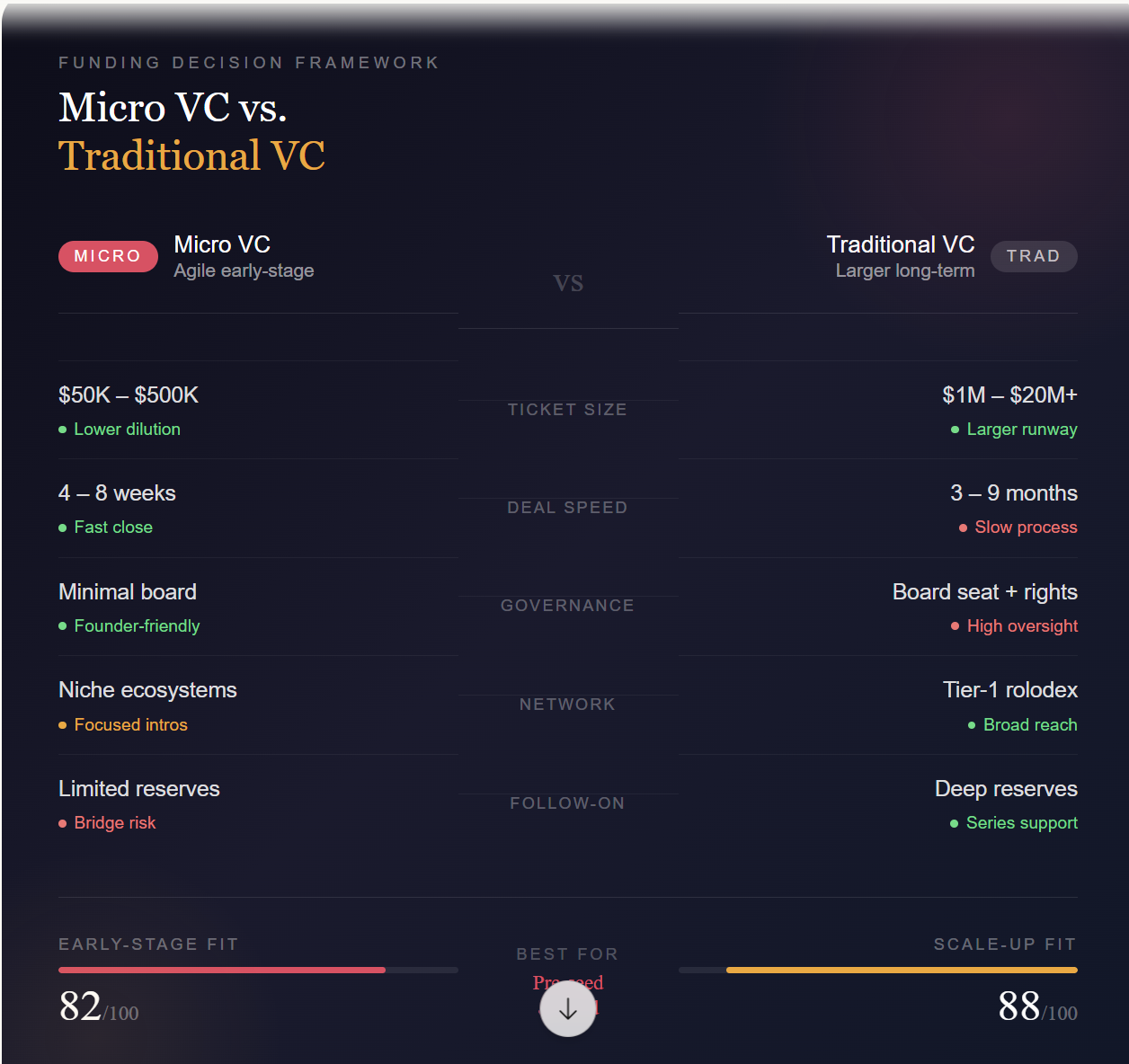
Over the past decade, the number of venture funds under USD 25 million has grown significantly, particularly in the United States and across Asia. These smaller funds fill a gap that large VC firms have structurally abandoned: the true early stage, where companies need conviction and operational support rather than committees and capital deployment targets.
In the United States, micro-VC funds now represent more than half of all new funds launched each year. In Asia, the model has expanded rapidly alongside fintech, digital commerce, and lean startup ecosystems that reward speed and focus over scale.
The reason is straightforward. Micro-VCs deploy capital faster, make decisions more nimbly, stay closer to founders, and take early-stage risks that large funds cannot justify. They target the stage where the most value is created — and where large funds simply cannot operate efficiently.
2. Smaller Funds Outperform at the Early Stage
Data from the Kauffman Foundation, AngelList, and PitchBook consistently shows that micro-VC funds below USD 25 million produce higher multiples at the early stage, with lower volatility and shorter paths to liquidity than their larger counterparts.
The reason is structural. Small funds do not need unicorns to perform. They exit early through strategic acquisitions, acquihires, and roll-ups. They enter earlier and at lower valuations. They can afford to be genuinely hands-on. And critically, they do not chase hype cycles or deploy capital into overvalued late-stage rounds simply to put money to work.
You do not need to be big to generate strong results. You need to be precise.
3. Lower Overhead Drives More Disciplined Behaviour
Large VC funds carry substantial fixed costs — teams of twenty to fifty people, expensive offices, complex legal infrastructure, and multi-layered management fees. These costs create pressure that shapes behaviour in ways that are not always aligned with investor interests.
Micro-VC firms typically operate with two to four partners, minimal bureaucracy, and simple direct governance. Less overhead means less pressure to chase oversized outcomes. Less pressure means more disciplined, patient, and sustainable investment behaviour. This lean structure is a feature, not a limitation.
4. Why This Trend Is Particularly Relevant to Fintech
Fintech is not a single industry — it is a collection of highly regulated, jurisdiction-specific, infrastructure-heavy businesses that require deep operational knowledge rather than generalist capital. Large funds rarely carry the expertise or the patience to navigate licensing requirements, cross-border compliance, and the long lead times that regulated financial businesses demand.
Micro-VC and boutique venture builders are better positioned to operate in this environment. Smaller teams with specific expertise, closer founder relationships, and the flexibility to work across multiple jurisdictions deliver genuine advantages in fintech — not just in venture generally.
5. Where Venture Capital Studio Fits
Venture Capital Studio builds on the same underlying logic as the micro-VC movement — small, disciplined, high-focus venture structures with lower capital requirements and shorter paths to profitability. But VCS extends the model further by adding asset-backing, multi-jurisdiction structuring, and direct operational involvement in each venture.
Where micro-VC brings agility, VCS adds the infrastructure depth that fintech ventures specifically require: legal, regulatory, compliance, and governance capabilities built into the platform from the outset. And where micro-VC typically relies on a single financing round, VCS deploys a two-stage capital model — private co-investment to fund the build, followed by a listed Swiss instrument to unlock institutional and private bank capital once real assets are established. The result combines the efficiency of micro-VC with the financing architecture of a professional investment platform.
Conclusion: Precision Over Scale
The next decade of venture capital will not belong to the largest funds. It will belong to the most precise ones — vehicles that know their market deeply, operate efficiently, and deliver consistent value without depending on rare, unpredictable outcomes.
Micro-VC is not a compromise. It is an evolution. And for fintech in particular, it is increasingly the only model that makes structural sense.
Venture Capital Studio is part of this shift — combining the discipline of micro-VC with the operational depth and financing architecture that serious fintech venture building demands.
Do not hesitate to contact us at insight@venturecapitalstudio.com or download our business card at vcs.card/renephilippe for more information.
