
How Long Can You Do Banking Without Being a Bank?
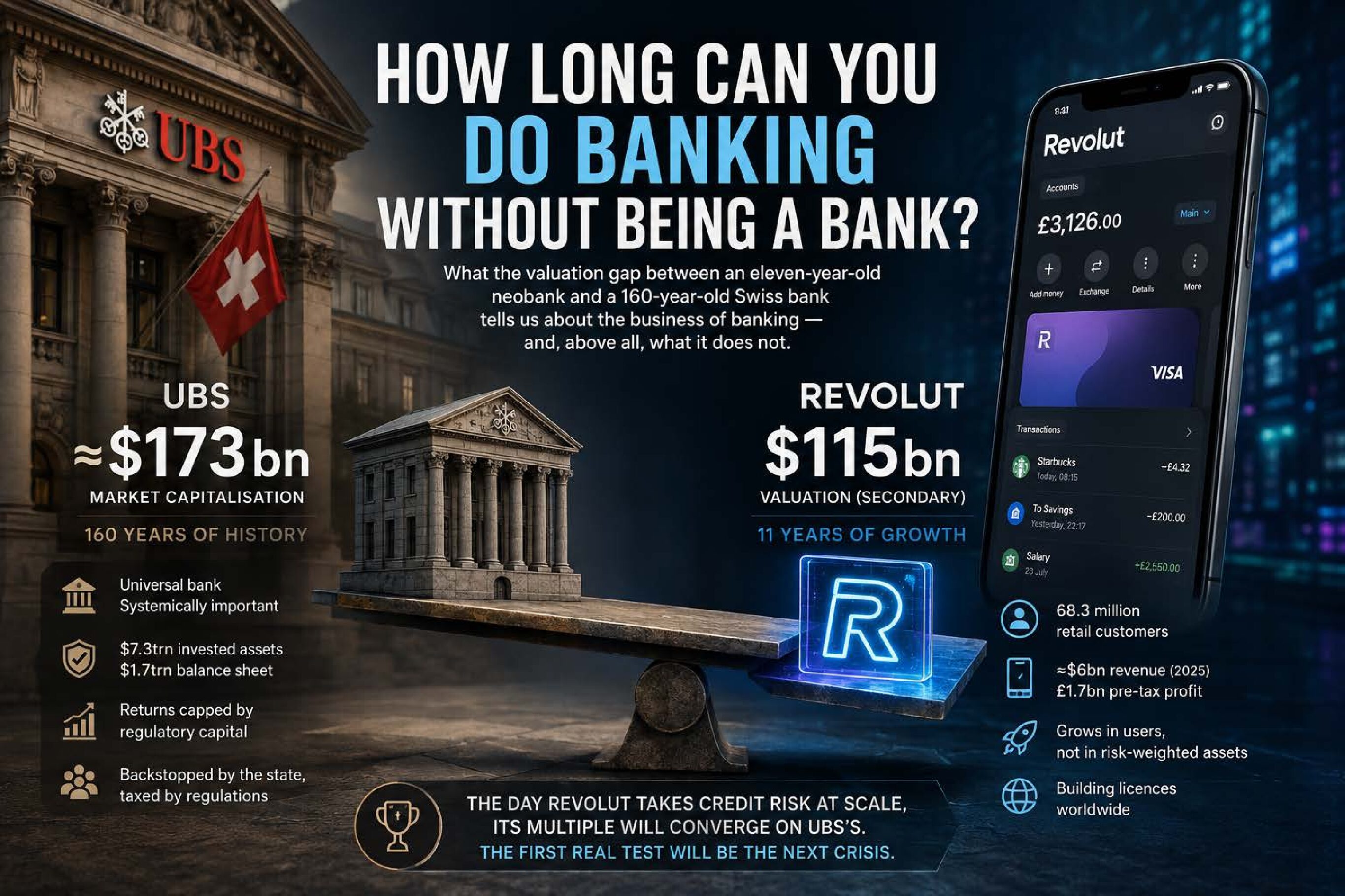
How Long Can You Do Banking Without Being a Bank? UBS at 173 billion, Revolut at 115: what the valuation gap between an eleven-year-old neobank and a 160-year-old Swiss bank tells us about the business of banking — and, above all, what it does not.
How Long Can You Do Banking Without Being a Bank
A house founded under Napoleon III, twice at the centre of a public rescue in fifteen years, its capital replenished with Gulf sovereign money. Facing it, an app born in 2015 in a London flat that has never lived through a credit cycle. The first is worth roughly 170 billion dollars on the market. The second changes hands at 115 billion in the secondary market and is telling investors about a listing somewhere between 150 and 200 billion.
The first reflex is to shout bubble. The second, more useful one, is to ask what the market is actually buying in each case. Short answer: not the same thing. It is not the same business — not yet.
1. The numbers, first
| UBS | Revolut | |
| Founded | 1862 (Bank in Winterthur); current form 1998; absorbed Credit Suisse in 2023 | 2015, in a London flat |
| Value | ≈ USD 165–173bn market capitalisation (early August 2026) | USD 115bn (secondary sale, July 2026); 75bn in Nov. 2025; 45bn in 2024 |
| Ambition | Complete the Credit Suisse integration by end-2026 | IPO targeted at USD 150–200bn (per the Financial Times) |
| Assets | USD 7.3trn of invested assets; USD 1.7trn balance sheet | No comparable balance sheet; 68.3 million retail customers |
| Results | USD 5.8bn net profit in H1 2026; CET1 at 14.4% | ≈ USD 6bn of 2025 revenue; GBP 1.7bn pre-tax profit (+57%) |
| Licence | Swiss universal bank, systemically important | Full UK banking licence since March 2026; US charter applied for |
Sources: UBS second-quarter 2026 results release (29 July 2026); Bloomberg (22 July 2026) on the Revolut secondary sale; Financial Times, picked up by the trade press on 21 April 2026, for the IPO range; Revolut and APRA announcements (21 July 2026); Reuters (23 April 2026) on France.
2. Back-of-the-envelope arithmetic
Measured against annualised revenue of roughly 55 billion dollars, UBS trades at about three times sales and some fifteen times earnings. Revolut, at 115 billion for around 6 billion of revenue, trades at close to twenty times sales and about fifty times profits. At 200 billion, you land on multiples normally reserved for software companies.
Put differently: the market does not value Revolut as a bank. It values it as a technology platform that happens to sell financial services. And it values UBS as exactly what it is — a balance sheet.
3. Regulatory capital is a tax on valuation
This is the point most often missed. Every franc of growth at a universal bank consumes hard capital, TLAC and regulatory liquidity. Growth there is mechanically expensive, and returns are capped by the CET1 ratio. Revolut’s model grows in users and payment volumes — that is, in software — rather than in risk-weighted assets.
Hence the multiple gap. It is not irrational: it reflects the difference between growth that demands capital and growth that (almost) does not.
4. A state backstop is no gift to shareholders
It is often said that large banks enjoy an implicit taxpayer guarantee, and that this should lift their valuation. In practice, for the shareholder, the opposite holds. Systemic status is paid for in capital surcharges, liquidity requirements and resolution constraints — and, in Switzerland, in a still-open parliamentary debate on the capitalisation of foreign subsidiaries, which UBS itself notes will shape the pace of its buybacks.
The guarantee protects the system; it taxes the shareholder. It also protects certain instrument holders rather poorly, as Credit Suisse’s AT1 investors discovered in March 2023.
5. What 115 billion means — and what it does not
A little methodological caution is in order. UBS’s market capitalisation is a market price: liquid, continuous, contestable every second by any seller. Revolut’s valuation is a negotiated price on a secondary sale covering a fraction of the share capital, in a context of scarcity — there are few assets of that size a private investor can still reach before an IPO.
These are not the same currency. A price set on 2% of the equity does not transpose mechanically to 100%. And two risks remain outside the price:
- Revolut has never managed a credit cycle. Its profits come largely from fees, foreign exchange and interest on placed deposits — not yet from a loan book tested by a recession.
- The regulatory conquest is unfinished. Full UK licence in March 2026, US charter applied for, mortgages and business lending in development: each of these steps moves Revolut closer to a balance sheet — and therefore to a balance-sheet multiple.
6. The licence race: Revolut is buying precisely what weighs UBS down
This is the most striking development of the past twelve months, and it has slipped past the valuation debate. Revolut is no longer content to passport a Lithuanian licence: it is building a full banking architecture, jurisdiction by jurisdiction.
- United Kingdom: full banking licence obtained in March 2026, after a mobilisation period opened in 2024.
- Mexico: full banking operations from January 2026 — its first bank outside Europe.
- Australia: authorised deposit-taking institution (ADI) licence granted by APRA on 21 July 2026, with the launch of Revolut Bank Australia and a commitment of nearly 400 million Australian dollars over five years. The group’s first banking entity in Asia-Pacific.
- United States: national bank charter application filed in March 2026 with the OCC and the FDIC.
- France: banking licence application under way, Paris chosen as Western European headquarters, one billion euros of investment announced over three years and a ten-year lease in the Bourse district.
- Elsewhere: a licence application in Peru, in-principle approval for crypto services in the UAE, and the Lithuanian licence retained as an EU passport.
The message is clear: Revolut wants to become a real bank. But the irony deserves to be stated plainly. Every licence obtained brings legitimacy, insured deposits and net interest margin — and, in the same movement, locked-up regulatory capital, a local prudential supervisor, liquidity and governance requirements, and exposure to regulatory litigation of which Revolut has already had a taste in Europe.
In other words: licence by licence, Revolut is buying precisely what caps UBS’s multiple today.
7. So why does UBS look like it is treading water?
Because maturity has cruel arithmetic. UBS gathered 73 billion dollars of net new money in wealth management in the first half of 2026 — a figure no neobank comes close to. Set against a 7.3 trillion base, that is roughly 1% growth. Revolut doubles off a small base. Going from 45 to 115 billion in valuation is arithmetically easier than adding a Revolut to UBS.
Next, UBS has not spent the past three years conquering markets: it has spent them digesting Credit Suisse. Global account migration completed in March 2026, more than 90% of legacy IT applications decommissioned, 12.6 billion dollars of cumulative cost savings. That is not inertia, it is digestion — work that produces no narrative, only deferred value.
Finally, a Swiss systemic bank does not set its own pace. The parliamentary debate on the capitalisation of foreign subsidiaries directly conditions the group’s buyback timetable. Hard to sprint when the regulator decides the length of the leash — and has excellent reasons to do so, given the bills of 2008 and 2023.
8. The final paradox
So the question is not “why is Revolut worth so much?”. It is: how long can you do banking without being a bank?
The day Revolut lends at scale, carries interest-rate and credit risk, and faces the same capital requirements as a systemic institution, it will start to look like UBS — and its multiple will converge on UBS’s. The first real valuation test will not be the IPO: it will be the first credit crisis it weathers with a balance sheet to defend, in five or six jurisdictions at once.
Symmetrically, UBS’s historical discount is not eternal. An integration completed by end-2026, 7.3 trillion in invested assets, a double-digit return on capital: if the memory of 2008 and 2023 eventually fades, the discount will narrow. The market prices memory; it also, in the end, forgets.
Last word
A hundred and sixty years of history do not automatically convert into market capitalisation, and eleven years of growth do not amount to a franchise. What the market is telling us in 2026 is that it currently pays more for convenience than for trust — because convenience scales, and trust is built client by client, generation after generation.
It is not necessarily wrong. But we will only know it was right after the next crisis, not before.
Note on method: figures as at 8 August 2026. Revolut valuations come from private transactions and press reports; they do not derive from any regulatory filing.
