
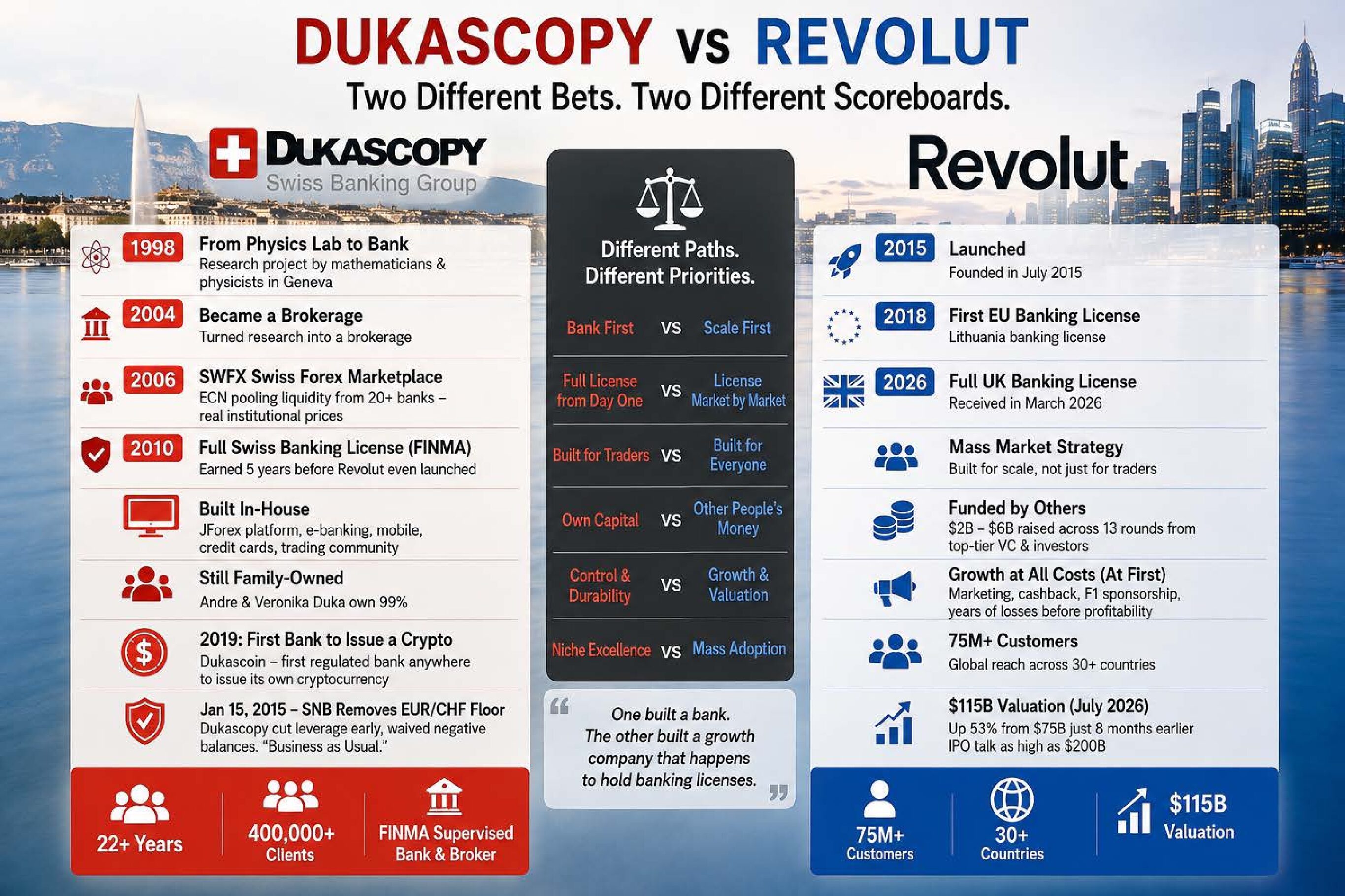
Before Revolut There Was Dukascopy
Before Revolut, There Was Dukascopy. Revolut gets called the poster child of fintech banking. Fair enough — 65 million-plus customers, a $115 billion valuation confirmed in a July 2026 secondary share sale (up 53% from $75 billion just eight months earlier, with IPO talk reaching as high as $200 billion), an app people actually use.
Dukascopy Bank vs Revolut Two Different Path
The Timeline Nobody Mentions
But “first” and “biggest” are not the same word, and on the forex side of the story, the timeline doesn’t favor Revolut.
From Physics Lab to Bank (1998 → 2004 → SWFX 2006)
Dukascopy started as a research project in 1998, run by a group of mathematicians and physicists in Geneva led by Dr. Andre Duka, applying tectonophysics to build a trading system.
That work became a brokerage in 2004. In 2006, Dukascopy launched the SWFX Swiss Forex Marketplace, an ECN pooling liquidity from more than twenty banks — real institutional price feeds passed through to retail and professional clients, not a marked-up spread dressed up as innovation.
The License That Came First (FINMA 2010 vs Revolut)
By 2010, Dukascopy had done what Revolut still hasn’t fully done in its home market: it earned a full Swiss banking license from FINMA. Revolut launched in 2015, got its first EU banking license from Lithuania in 2018, and only picked up a full UK banking license in March 2026.
So, by the time Revolut existed, Dukascopy had already been a licensed bank for five years.
Built In-House, Not Borrowed (JForex, e-banking, credit cards)
Dukascopy has its own proprietary platform (JForex) — built in-house rather than white-labeled from MetaTrader, as most retail brokers do — mobile and e-banking, credit cards, and an online trading community with video conferencing.
Features that took the neobank generation another decade to market as “disruption.”
Still Family-Owned (Duka founders, 99%)
It’s still run by the same founders, Andre and Veronika Duka, who hold 99% of the company. Twenty-two years in, over 400,000 clients, FINMA-supervised as both bank and broker.
Credit Where Due – A Few More Firsts
In 2019, Dukascopy Bank became the first Swiss bank — and by its own account, the first regulated bank anywhere — to issue a cryptocurrency, the Dukascoin, after FINMA gave it the green light.
Revolut added crypto trading to its app; Dukascopy issued its own token under a full banking license, which is a different order of regulatory achievement.
Business as Usual, While Everyone Else Burned
Then there’s January 15, 2015 — the day the Swiss National Bank abandoned its EUR/CHF 1.20 floor without warning, sending the franc up roughly 20-30% in minutes and wiping out retail FX brokers overnight.
Dukascopy had already cut EUR/CHF leverage to 1:10 back in October 2014, anticipating exactly this scenario, and came through the day calling it “business as usual” — it waived clients’ negative balances rather than chasing them for the shortfall (how many banks cover for their client losses).
Revolut wasn’t even around to get hurt — it wouldn’t be founded for another six months.
Others weren’t so lucky:
Swissquote had to set aside a CHF 25 million provision for client losses, Alpari UK collapsed into insolvency within hours, and FXCM — the largest US retail FX broker — was left owed $225 million by wiped-out clients and needed an emergency $300 million loan that ultimately cost its founders control of the company. Risk management that boring is exactly what you want from a bank.
Then Why Isn’t Dukascopy the Size of Revolut?
Fair question. If the tech and the timing were there, why does Dukascopy have 400,000 clients and Revolut has 75 million-plus? Was Dukascopy simply unable to become Revolut? No — it’s not that Dukascopy couldn’t. Becoming Revolut requires accepting a specific set of trade-offs that the Duka family, by all appearances, never wanted to make.
Other People’s Money vs. Its Own
Revolut’s growth ran on other people’s money — roughly $2 to $6 billion raised across thirteen rounds from Balderton, Index, DST, TCV, SoftBank and others. That capital exists to be spent on acquisition, not preserved on a balance sheet: marketing, cashback, an Audi F1 sponsorship, years of losses before the company turned meaningfully profitable in 2023 and 2024. It also ran on a lighter regulatory footing at the start — an e-money license lets you onboard customers fast; a full banking license, which Revolut only assembled market by market, comes with capital ratios and compliance overhead that don’t move at start-up speed.
The Trade-Offs Dukascopy Didn’t Take
Dukascopy took the opposite route on every one of those variables. Full FINMA banking license first, in 2010 — built everything on top of that constraint rather than around it. Stayed 99% owned by its founders: no venture round, no dilution, no investor demanding a path to a $115 billion valuation. And a product built for traders who understand a spread and an ECN, not for a mass audience who wants a card for their holiday money. A $1,000 minimum deposit is a filter, not a failure to remove one.
Two Different Scoreboards
Both bets have paid off, just on different scoreboards. Revolut’s bet paid off in valuation and reach — a legitimate outcome, and a hard one to pull off.
Dukascopy’s bet paid off in control and durability: twenty-two years, no external shareholders to answer to, profitable as a niche Swiss bank without ever needing a growth round to survive a bad quarter.
One measures success in monthly active users and secondary share sales. The other measures it in staying independent and still standing after two decades in a business where most disappear.
So the honest framing isn’t “Dukascopy fell short of Revolut.” It’s that they were never playing the same game. One built a bank. The other built a growth company that happens to hold banking licenses. Neither of those is the wrong answer — but only one of them was trying to become Revolut.
